American Arabesque: Arabs and Islam in the Nineteenth Century Imaginary (America and the Long 19th Century) by Berman Jacob Rama
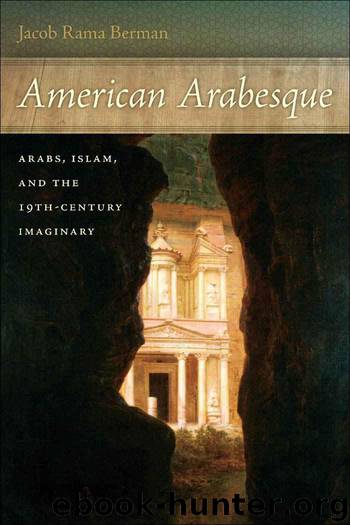
Author:Berman, Jacob Rama [Berman, Jacob Rama]
Language: eng
Format: mobi
Publisher: NYU Press short
Published: 2012-06-10T16:00:00+00:00
4 American Moors and the Barbaresque
Standing on the shores of Morocco just prior to returning to Harlem in the 1930s, the Caribbean writer Claude McKay pays romantic homage to the Barbary Coast almost a century and a half after the word Barbary circulated in American print culture as an indicator of savagery and slavery. “The Moroccans are a magical barbaric people,” McKay announces, “if one isn’t too civilized to appreciate the subtlety and beauty of their barbaresques.”1 Federal-era American captives in North Africa used the term Barbary as a discursive tool to establish the civilized mandates of the new, slave-owning, U.S. nation. In the process of projecting nascent nineteenth-century American racial hierarchies across a global field and presenting American secular democratic values as universal, these working-class sailors also anxiously acknowledged their country’s multicultural composition. McKay, in the post–World War I Jim Crow years, tropes Barbary in order to blend the categories of civilized and savage and undercut the logic of segregation.
By “-esqueing” Barbary, McKay twists the trope of barbarism, associated with Africa, into a question of taste—a transhistorical and transspatial marker of civilization. Barbary captives used aesthetic categories such as appreciation for architectural beauty and literacy to differentiate their civilized status from the barbarous status of their North African captors. McKay disassociates taste and civilization, opening up a semantic space of appreciation for the barbaric. Improvising on the discourse of primitivism, McKay vernacularizes Barbary, changing it into a “barbaresque” that speaks to African subtlety and beauty, as well as the limits of civilized America’s cosmopolitan artistic sensibility. To further complicate the twist on the Barbary trope McKay enacts, his ode to Moroccan “barbaresques” is followed by a formalist poem that indulges in blatant images of Orientalist fantasy, including a line that praises dancing “fatmahs shaking their flamenco feet.”2 McKay seizes the right to gaze on African culture with the eyes of civilized distance, as well as with the sympathies of primitive taste. In doing so, McKay situates himself as a black Orientalist who both inherits and revises a white discourse on civilized superiority. Rather than use North Africa as a screen through which to negotiate the anxieties of white privilege in America, as Barbary captives did, McKay uses North Africa to explore the privileges of blackness.
This chapter borrows McKay’s term “barbaresque” and applies it to the representations of Arabs and Islam found in early twentieth-century black discourses on American national identity. These representations are hardly consistent and often speak directly to differences in theories on self-representation, as well as to the aesthetic divides that these differences engender. For instance, W. E. B. DuBois, champion of the “talented tenth,” mines African Islam as a source of racial pride, especially in the late The World and Africa, and occasionally co-opts Arab history as African history. On the other hand, McKay, voice of the “debauched tenth,” offers more fraught accounts of the relationship between Arabness and Africanness. His engagements with Arab race and Islamic culture ultimately allow him to narrate a form of black Orientalism and a form of primitivism.
Download
This site does not store any files on its server. We only index and link to content provided by other sites. Please contact the content providers to delete copyright contents if any and email us, we'll remove relevant links or contents immediately.
| Anthropology | Archaeology |
| Philosophy | Politics & Government |
| Social Sciences | Sociology |
| Women's Studies |
The Secret History by Donna Tartt(19103)
The Social Justice Warrior Handbook by Lisa De Pasquale(12197)
Thirteen Reasons Why by Jay Asher(8919)
This Is How You Lose Her by Junot Diaz(6894)
Weapons of Math Destruction by Cathy O'Neil(6284)
Zero to One by Peter Thiel(5808)
Beartown by Fredrik Backman(5767)
The Myth of the Strong Leader by Archie Brown(5513)
The Fire Next Time by James Baldwin(5454)
How Democracies Die by Steven Levitsky & Daniel Ziblatt(5225)
Promise Me, Dad by Joe Biden(5157)
Stone's Rules by Roger Stone(5091)
A Higher Loyalty: Truth, Lies, and Leadership by James Comey(4966)
100 Deadly Skills by Clint Emerson(4931)
Rise and Kill First by Ronen Bergman(4797)
Secrecy World by Jake Bernstein(4756)
The David Icke Guide to the Global Conspiracy (and how to end it) by David Icke(4723)
The Farm by Tom Rob Smith(4517)
The Doomsday Machine by Daniel Ellsberg(4493)
